
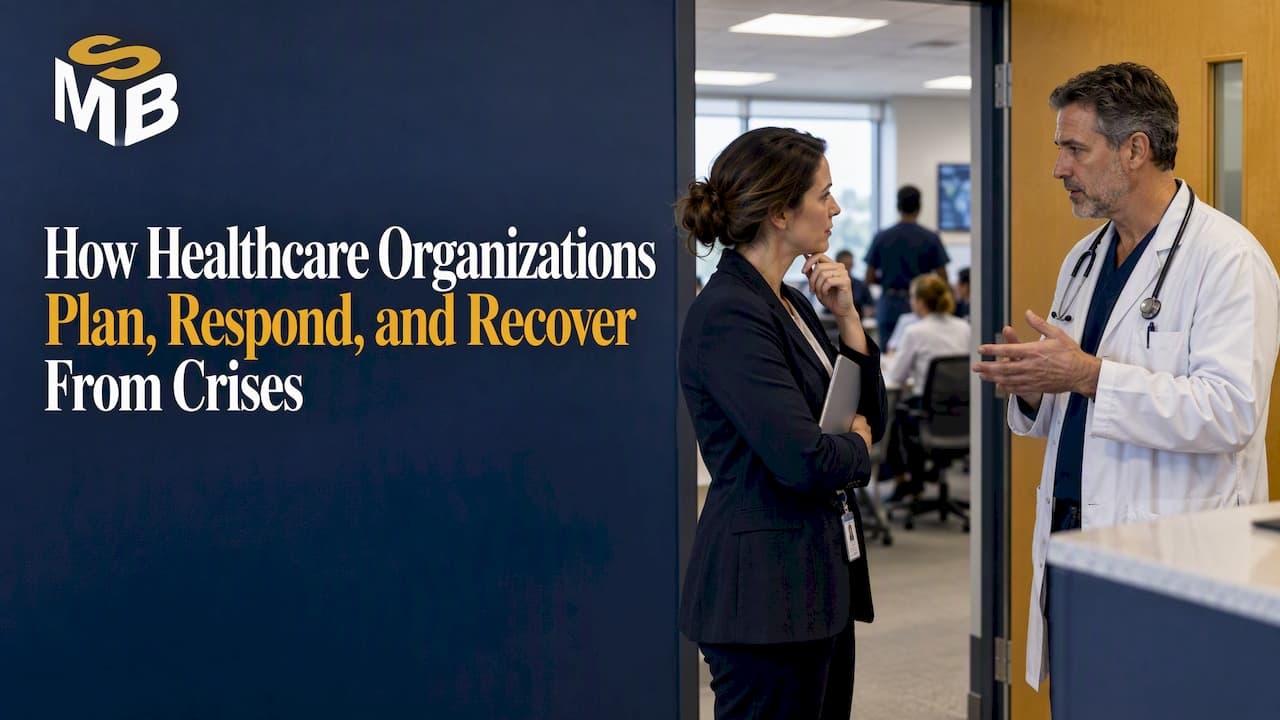
Healthcare crisis communications is the work of telling patients, staff, regulators, the media and the public what is happening, what you know, and what you are doing about it, while the situation is still unfolding. It is built long before the emergency: a written plan, named people, tested channels and a habit of honesty. This guide walks through each stage, from preparation to the first hours to rebuilding trust, for the executives and boards who carry the responsibility.
TL;DR
- A written, leadership-endorsed plan is the foundation. The CDC says that without one, an organization is at an extreme disadvantage when a crisis hits.
- Speed, accuracy, credibility, empathy, a call to action and respect are the six principles that guide effective emergency communication.
- Say what you know, what you don't know, and what you are doing to find out. Never speculate.
- Reach vulnerable groups through trusted community partners and professional translators, and watch for rumors from the first hour.
- After the crisis, evaluate what worked, record lessons learned and revise the plan.
Table of Contents
- Why the Plan Comes Before the Crisis
- What a Healthcare Crisis Communication Plan Should Include
- The First Hours: Be First, Be Right, Be Credible
- Speaking With Empathy When You Don't Have the Answers
- Reaching Every Community, and Answering Misinformation
- Your Staff Are Your First Audience
- Perspective: What Thirty Years Teaches About Healthcare Crises
- Learning From the Crisis and Rebuilding Trust
- How We Help Healthcare Organizations
- FAQ
- Sources
Why the Plan Comes Before the Crisis
Most leaders agree a plan is wise. Fewer write one down. The day-to-day of a hospital system, clinic group or health-focused nonprofit is already crowded, and a plan for something that has not happened yet slides down the list.
The cost of that delay is well documented. The CDC's crisis communication planning guidance states that planning is a foundational activity. A plan does not guarantee a good outcome, but the lack of one puts you at an extreme disadvantage. That is a careful claim, and I think it is the right one. A plan is not a script that makes trouble disappear. It is a way of making sure the first hour is spent acting, not arguing about who should be speaking.
Think of it as the relay race that every leadership team runs. A crisis hands the baton from the compliance officer to the physician lead to the communications director to the CEO. Every handoff that was rehearsed is smooth. Every handoff that was improvised is a place where the baton drops, and in healthcare the audience is watching, often frightened, and often with a personal stake.
Healthcare is also different from most industries because the crisis may be about someone's body, safety or privacy. A data breach, a patient safety event, an infectious disease cluster, a workplace violence incident, a lawsuit, an executive departure, a clinic closure: each one touches trust in a way a product recall rarely does. If you want a broader foundation first, our guide to what a crisis communication plan should include covers the general structure, and this article applies it to the healthcare setting.
What a Healthcare Crisis Communication Plan Should Include
The CDC's planning guidance gives a clear list of the essentials. According to the same CDC planning document, a plan should include:
signed endorsement from senior leadership, designated responsibilities for the teams that handle public information, contact lists for the media and for emergency-response partners, and procedures for verifying information and clearing it quickly. Each of these deserves a closer look.
Leadership endorsement
A signature may sound like paperwork. It is not. When the plan says the communications lead can release a holding statement without waiting for three sign-offs, that authority has to come from the top, and it has to be agreed in advance. Boards and executive teams that sign the plan are far less likely to override it under pressure.
Clear roles
Name the people, not just the titles. Who is the spokesperson for clinical questions? Who speaks for the organization when the question is legal, financial or about a patient's privacy? Who updates staff? Who monitors social media and local news? Who talks to regulators and your insurers? The CDC adds that the planning committee should include people knowledgeable about each topic the plan covers, so a plan written by communications alone will have gaps that clinical, legal, IT and facilities leaders can fill.
Contact lists that work
A list is only useful if it is current and reachable at 2 a.m. Include reporters who cover health in your region, public health agencies, emergency-response partners, board members, legal counsel and the community leaders you rely on. Test it. Call people. Replace the numbers that no longer work.
Verification and fast clearance
This is the part that most often breaks. In healthcare, facts change quickly and a wrong statement can harm patients or expose the organization. A good plan defines who confirms a fact, how it is logged, and how it reaches the spokesperson within minutes, not hours. It also defines what can be said before verification is complete, which is usually an acknowledgment, an expression of concern and a promise of the next update.
Prepared, not pre-written
Draft holding statements and templates for the scenarios you are most likely to face. A readiness review helps here: a candid look at your vulnerabilities, from patient data security to staffing shortages to local media relationships. Our crisis communications policy guide shows what belongs in writing and what is better left to judgment.
The First Hours: Be First, Be Right, Be Credible
The CDC describes effective emergency communication through six principles: be first, be right, be credible, express empathy, promote action and show respect. They sound simple, and they pull against each other. Speed can undermine accuracy. Caution can look like evasion. The skill is in managing that tension.
Why does being first matter so much? The CDC notes that, for the public, the first source of information during a crisis often becomes the preferred and trusted one. If you are silent, someone else fills the gap, and that someone may be a rumor on social media. The CDC's guidance on messages and audiences goes further: the speed of releasing lifesaving information signals how prepared you are, and silence is often read as inaction.
Being first does not mean being complete. It means being present. A good first statement does three things:
It acknowledges the event plainly. It tells people what you are doing, such as activating your response team, contacting affected patients or working with public health authorities. And it tells them when they will hear from you again. Then you keep that promise, even if the update is that nothing has changed.
A quick illustration
Imagine a regional health system discovers that a vendor has exposed patient records. The legal team wants a day to review. IT wants more time to understand the scope. Communications knows the news will break by afternoon. If the plan is clear, the organization issues a short, honest holding statement within hours: we have identified an incident, we are investigating, we are securing the systems, and we will notify affected patients directly. It does not guess at numbers. It does not assign blame. It tells patients where they can get answers. The detailed notice comes when the facts are verified.
If the plan is absent, that same afternoon is spent in a conference room while the story is told by someone else.
Speaking With Empathy When You Don't Have the Answers
Healthcare leaders are trained to be certain. A crisis often forces them to say they are not. That can feel like weakness. It is the opposite.
The CDC's guidance tells communicators to express empathy and acknowledge fear, pain, suffering and uncertainty. It also tells them to state what is known, what is not known and what is being done to find out more, without speculating. Credibility, it adds, is established through empathy, openness, competence and expertise.
The order matters. In a CDC presentation on H1N1 communication, risk communication expert Vincent Covello noted that people who are stressed and concerned typically care more about whether you care than about how much you know (CDC H1N1 grand rounds). So the first sentence of a statement should not be a policy citation. It should be a human acknowledgment.
A practical way to structure any message is a simple sequence: what happened, what it means for the people listening, what you are doing, what they can do, and when you will update them next. Leave out the adjectives. Leave out the defensive qualifiers. Do not promise outcomes you do not control.
A word on legal review. Counsel will rightly worry about admissions of liability, and in healthcare there are also privacy rules to respect. But expressing concern is not the same as admitting fault, and a statement that reads as cold can do as much damage as a careless one. Bring counsel into the plan early so that the review is a quick pass, not a negotiation. Our guide to litigation communications for leaders and counsel explains how communications and legal strategy can work together.

Reaching Every Community, and Answering Misinformation
A statement that reaches only English-speaking, internet-connected adults has not reached your community. Healthcare crises often hit hardest those who are hardest to reach: older patients, people with limited English, rural families, people who distrust institutions.
The AHRQ's health literacy guidance recommends partnering with community and faith-based leaders to bridge those gaps, and tailoring messages to the cultural and linguistic needs of specific populations. The point is practical. People often act on health information when it comes from someone they already trust, and a hospital may not be that someone for every neighborhood. Build those relationships before you need them, not during a crisis.
Use professional translators
It is tempting to run a statement through a free translation tool and post it. Don't. AHRQ's patient safety network warns that machine translation in clinical settings, without professional human review, can lead to dangerous miscommunication, because these tools often fail to interpret clinical information accurately. Budget for professional translators and keep a roster of them in your plan.
Watch the information environment
The World Health Organization describes an infodemic as an overabundance of false or misleading information, and recommends managing it through social listening, rumor monitoring and sharing trustworthy information. The same guidance emphasizes that communities are the primary source of capacity in emergencies, and that engaging them in designing the response promotes trust and accountability.
For a healthcare organization, that means someone is assigned to read what is being said online and in local groups, log recurring rumors, and decide which deserve a correction. Not every false claim needs an answer. Some answers only amplify the claim. But a rumor that could cause someone to skip treatment, or avoid a facility, needs a clear, calm reply from a credible voice.
Your Staff Are Your First Audience
When a crisis breaks, patients and reporters call. But so do your own employees, and what they hear from you shapes what they say to everyone else. Nurses, front-desk staff and physicians are the faces of your organization at the exact moment it is under scrutiny.
Research on emergency department workers during the early COVID-19 response found that frequent and redundant communication caused problems with information delivery and uptake, and worsened anxiety and interpersonal tension. More messages are not better messages. Staff need one reliable channel, a predictable rhythm of updates and clear guidance on what they may say and where to send media questions.
The same study describes crisis team leaders building intranet pages for fast communication and holding virtual town halls. The specifics will vary by organization, but the principle holds: give people a single place to look, and tell them when it will next be updated. Silence invites speculation inside the building just as it does outside.
Perspective: What Thirty Years Teaches About Healthcare Crises
We have spent more than 30 years helping organizations prepare for crises and respond to them, and healthcare has a particular weight. The temptation in any crisis is to treat communication as a product: write the statement, send it, move on. We see it differently. Communication is the visible part of a process, and the process is what people actually judge.
That is why our work combines preparation with real-time response. The organizations that handle difficult moments best are rarely the ones with the most polished language. They are the ones that decided in advance who would speak, what they would value, and what they would do when the facts were uncomfortable. Words that are not matched by credible action are noticed quickly, and in healthcare they are remembered for years.
If we could offer leaders one shift in thinking, it would be this: a crisis is not only a threat to be contained, it is a test of the organization's character that the public is watching in real time. Handled with candor and care, it can become a reason people trust you more. Handled defensively, it confirms their doubts. Reputation is built in the long stretches between crises, through the same habits of honesty that a good plan puts on paper. For a closer look at the preventive side, see our practical guide to reputation risk mitigation.
— Mark
Learning From the Crisis and Rebuilding Trust
The crisis is not over when the headlines fade. Trust is rebuilt in the weeks and months afterward, and it is rebuilt through what you do, not what you say about what you did.
The CDC's community engagement guidance recommends engaging communities throughout a crisis, evaluating your communication efforts, discussing lessons learned and revising your plans for future emergencies. The evaluation does not have to wait for the end. The CDC's introduction to crisis communication notes that ongoing evaluation during the event, through feedback loops and media monitoring, is critical for tailoring messages and spotting information gaps in real time.
A useful after-action review asks plain questions. How quickly did we make the first statement? Did spokespeople have the facts they needed? Which audiences did we miss? What rumors spread, and how long did they last? Did staff feel informed? Did our actions match our words? Write down the answers, assign owners to the fixes and update the plan while the memory is fresh.

Then close the loop with the people affected. Tell patients and the community what you changed. A short, specific account of the improvements, delivered by a senior leader, does more for credibility than a broad pledge to do better.
How We Help Healthcare Organizations
If your organization has no plan, an outdated one, or a plan that has never been tested, we can help. Mark Brown Strategies offers crisis readiness assessments, tailored crisis communication plans, real-time crisis response, reputation management and recovery, corporate communications, community relations and litigation support, backed by a network of experts when a situation needs specialized counsel.
To talk through your situation, whether you are preparing or already in the middle of something, visit Mark Brown Strategies and tell us what you are facing.
FAQ
What is healthcare crisis communication?
It is the process of giving patients, staff, partners, the media and the public accurate, timely information during an unexpected event that threatens safety, operations or reputation. It covers the plan you write beforehand, the messages you deliver during the event and the evaluation afterward. The CDC defines crisis communication as providing facts to the public about an unexpected emergency.
Who should be on a healthcare crisis communication team?
The CDC advises that the planning committee include people knowledgeable about every topic the plan covers. In practice that means communications, clinical leadership, legal counsel, compliance and privacy, IT, human resources, facilities and an executive with authority to decide. Add community liaisons if you serve populations that need targeted outreach.
How fast should a hospital respond to a crisis?
As fast as it can say something accurate. The CDC guidance treats speed as a sign of preparedness and warns that silence is often read as inaction. A short holding statement that acknowledges the event, describes your first steps and promises an update is better than waiting for every detail.
How do you communicate when you don't have all the facts?
Say what you know, what you do not know and what you are doing to find out, and avoid speculating. Express concern for the people affected before you explain anything else. Then give a time for your next update and keep to it.
How often should a crisis communication plan be reviewed?
Review it after every real event and after every drill, and at least whenever leadership, systems or contact details change. The CDC recommends revising plans after lessons learned are discussed, so treat the plan as a living document, not a binder on a shelf.
Sources
- CDC, CERC: Crisis Communication Plans
- CDC, CERC: Introduction
- CDC, CERC: Messages and Audiences
- CDC, CERC: Community Engagement
- CDC, H1N1 Risk and Crisis Communication: Successes and Challenges
- AHRQ, Health Literacy Universal Precautions Toolkit
- AHRQ PSNet, Translating From Normal to Abnormal
- WHO, Risk communication, community engagement and infodemic management
- Centralization and Democratization: Managing crisis communication in emergency departments