
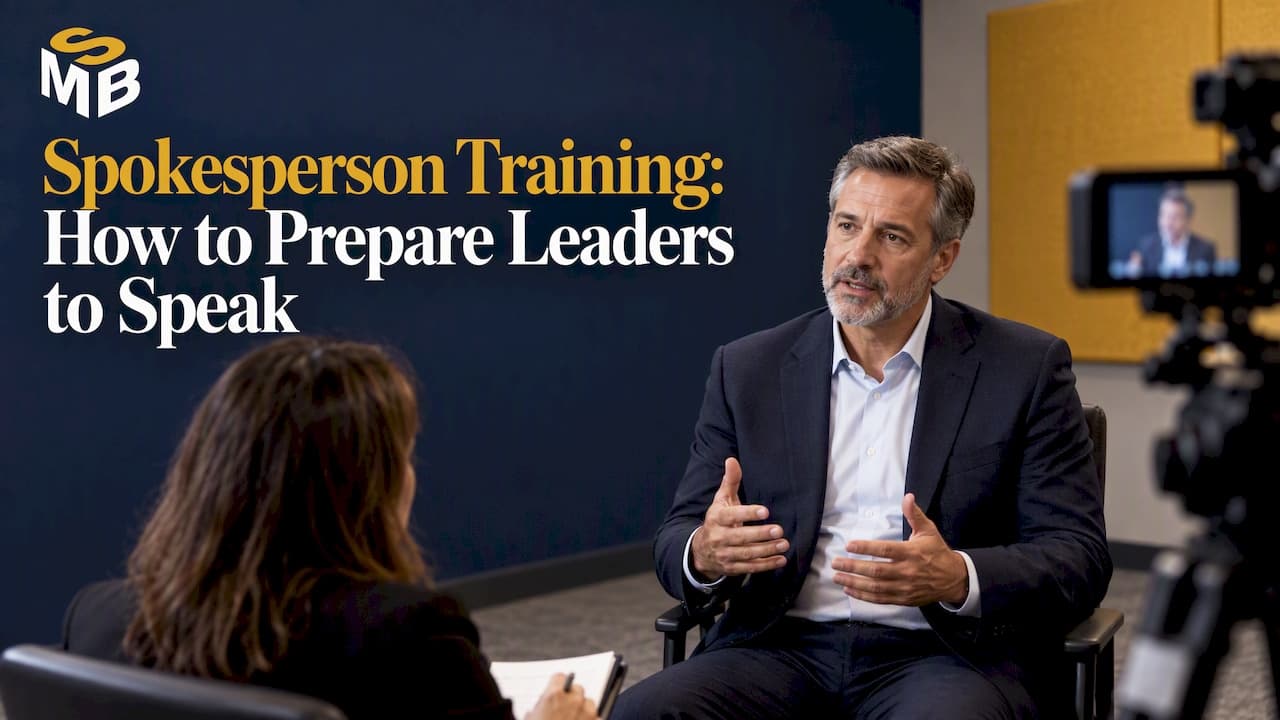
Spokesperson training is coaching that prepares the people who speak for your organization to deliver clear, consistent, honest answers when reporters, regulators, employees or the public are listening. It covers choosing the right people, building key messages, practicing hard questions on camera, and repeating the drill often enough that the skill holds when the pressure is real. If you wait until a crisis to find out who can speak for you, you are already behind.
TL;DR
- Spokesperson training teaches selected leaders to deliver key messages, handle hostile questions and stay credible under pressure.
- Choose spokespeople for subject knowledge and clarity, not rank alone. A title does not make someone a good communicator.
- Good sessions include message development, mock interviews on camera and crisis scenarios with honest feedback.
- Skills fade. Plan refreshers and tabletop exercises through the year, not a single workshop.
- Cost depends on format, group size, customization and how much crisis planning is bundled in, so scope it before you compare quotes.
Table of Contents
- What spokesperson training is, and who needs it
- Choosing who speaks for you
- What good training actually covers
- A format that fits your organization
- How much does spokesperson training cost?
- Keeping spokespeople ready after the training
- Perspective
- Work with us on spokesperson readiness
- FAQ
- Sources
What spokesperson training is, and who needs it
A spokesperson is the human face of your organization at the moment people most want answers. The CDC's crisis communication manual describes the spokesperson as a critical human connection that helps the public move from crisis toward resolution and recovery. That is a heavy job to hand to someone who has never faced a microphone with a skeptical reporter on the other end.
Training closes that gap. It is practical work: what you want to say, how you say it in a sentence or two, what you will be asked, and how you stay steady when the question is unfair.
Who needs it? Any organization that could land in the news, and that is more organizations than most boards assume. In our work we see the need most often in a few places:
- Companies under public or regulatory scrutiny, including casinos, healthcare systems, financial services firms and technology companies.
- Law firms and their clients, where every public word can affect a case.
- Nonprofits and schools whose reputation is the main asset.
- New companies entering a market like Las Vegas, where the first public impression is formed quickly.
It is also not only about bad news. Product launches, executive appointments, new ad campaigns and corporate wins all put leaders in front of reporters. A spokesperson who is comfortable in good times is far better prepared for bad ones.
Choosing who speaks for you
The instinct is to send the CEO every time. Resist it. Guidance for communicators from PRSA says to choose spokespeople for subject matter expertise and the ability to speak with clarity, empathy and confidence, rather than rank alone. The CDC says much the same: pick people who know the subject and can explain it clearly and confidently.
Match the speaker to the severity
The same PRSA guide suggests reserving the CEO for the most severe, Level III crises and assigning lesser incidents to other suitable spokespeople. There is wisdom in that. If your chief executive appears for every minor issue, you have nowhere to escalate when something serious happens.
In practice, we help clients build a short bench:
- A primary spokesperson who is on call and fully trained.
- A technical expert for questions in a specific field, such as clinical care, safety or finance.
- A senior executive held in reserve for the moments that demand top-level accountability.
- A backup for each of them, because crises do not respect vacation schedules.
The bench should come out of your crisis plan, not be improvised. If you do not have one yet, our guide to building a crisis communication plan shows where spokesperson roles fit.
Build a team behind the voice
A spokesperson is only as good as the people feeding them facts. PRSA's planning guidance recommends a cross-functional crisis team that includes HR, legal, operations and communications. Legal review matters especially when litigation is possible, and we cover that balance in our piece on litigation communications.
What good training actually covers
I like to think of a spokesperson as a relay runner. The facts, the approvals and the message are the baton, and the runner's job is to carry it cleanly across the line without dropping it or running in the wrong lane. Training is the practice on the track.
Message development
Everything starts with knowing what you want to say. The CDC advises that spokespeople should be involved in developing the key messages they will deliver. That makes sense. People deliver words they helped shape far more convincingly than words handed to them ten minutes before air.
A strong session usually produces:
- Two or three key messages, each short enough to say in a breath.
- Proof points, meaning facts or examples that back each message.
- A bridge from tough questions back to those messages.
- A Q&A document covering likely questions from each audience: reporters, employees, customers, regulators and investors.
PRSA's guidance points to comprehensive Q&A documents for various stakeholders as part of preparation, and it is the part organizations most often skip.
Techniques for difficult questions
The CDC's manual gives a clear set of habits: use key messages and short sentences, use bridging to return to your message, avoid speculation, and offer to follow up when you do not know the answer. It also advises against "no comment." If you cannot answer, say why, for example because the investigation is not finished, and say when you expect to know more.

Three habits do most of the work:
Answer first, then bridge. Respond to the question honestly in a sentence, then move to the point you came to make. Dodging the question entirely is what viewers remember.
Never guess. "I don't know yet, and here is how we will find out" builds more trust than a confident error that must be retracted tomorrow.
Lead with people. Early in a crisis, people want to know whether they are safe and whether you care. Facts about process come after.
That last point has research behind it. The PRSA guide states that empathy, honesty and openness account for 80 to 85 percent of how people determine trust in a crisis, with competence and expertise making up the remaining 15 to 20 percent. Expertise gets you in the room. Empathy keeps the audience listening.
Mock interviews and crisis scenarios
Reading about technique does little. Practice does everything. PRSA describes training that can include on-camera practice, media simulations and mock press conferences, with feedback on tone and delivery.
Here is a quick illustration of how that looks in a session. Imagine a hospital administrator who is excellent in a boardroom. We sit her in front of a camera and a trainer playing a local reporter. The first round goes well. In the second round, the reporter interrupts, cites a patient complaint she has not seen, and asks whether leadership covered it up. We watch the replay together. She notices she looked down, spoke faster and used internal jargon. Then she runs it again. By the third round she acknowledges the concern, says what she can confirm, and commits to a follow-up time. The improvement is visible, and she can see it for herself.
Sessions are most useful when the scenarios are drawn from your own risks: a data breach, a workplace incident, a lawsuit, a layoff, a product failure, a social media storm. We have published nine examples in our tabletop exercise scenarios, and many make excellent interview drills. If your sector is healthcare, see our guide to healthcare crisis communications for the scenarios that tend to arise there.

A format that fits your organization
Training comes in a few common shapes, and the right one depends on who is being trained and why.
| Format | Best for | What it usually involves |
|---|---|---|
| One-on-one coaching | CEOs, founders, executives facing a specific event | Private practice, tailored questions, on-camera replay |
| Small group workshop | A spokesperson bench or leadership team | Shared message work, rotating mock interviews, peer feedback |
| Scenario-based crisis drill | Organizations with a crisis plan to test | Realistic incident, timed updates, press conference simulation |
| Refresher session | Previously trained spokespeople | Short practice on new risks, new messages, new reporters |
Virtual sessions can work well for refreshers and for dispersed teams. For first-time training, we favor in-person practice when possible because body language and presence are so much easier to read.
How much does spokesperson training cost?
People ask this constantly, and honest answers are frustrating: it depends. Published prices differ widely between providers and are rarely tied to a standard menu. The main factors that move a quote are:
- Format. One executive for a half day is a different engagement from a team over several days.
- Customization. Generic coaching costs less to prepare than sessions built around your actual risks, audiences and Q&A.
- Scope. Some engagements include message development, crisis plan review or follow-up coaching. Others are a single workshop.
- Production. Cameras, a simulated newsroom or a trainer who plays a veteran reporter add preparation.
- Travel and location. In-person work across several cities adds logistics.
When you compare proposals, check that they cover the same things. A lower price for a generic session is not comparable to a fuller program with preparation and follow-up. Ask who actually delivers the training, what experience they have in your sector, and whether the work connects to your crisis plan.
Our services are fee-for-service consulting engagements and we do not publish a price list, because the right scope depends on your situation. We scope each engagement after a conversation about your risks and goals.
Keeping spokespeople ready after the training
A one-time workshop fades. Skills decay, people change roles, and the risks your organization faces shift. PRSA's planning guidance recommends annual reviews of the crisis framework, biannual tabletop exercises and regular training. That is a sound baseline.
Here is a rhythm we suggest to clients, adapted to their size:
- After any real incident or exercise, hold a short debrief. Our guide to after-action reviews explains how to make them change behavior rather than just record it.
- Refresh your Q&A document whenever a new risk, product, lawsuit or leadership change appears.
- Add new spokespeople gradually so the bench does not depend on one person.
- Write down who may speak, on what topics and with whose approval. A crisis communications policy turns those decisions into something you can point to at two in the morning.
These pieces belong inside a wider crisis management framework, and a well-trained spokesperson is one of its strongest components. They also support reputation risk mitigation, since many reputational wounds are self-inflicted by a poor first statement.
Perspective
Over thirty years of advising organizations, we have noticed a pattern. Leaders rarely fail in a crisis because they lack intelligence or good intentions. They fail because the first public words are unplanned, and those first words set the frame everyone else uses.
That is why we treat spokesperson training as part of preparation and not as a standalone workshop. The best-prepared clients know who speaks, what they can say, and who is behind them with facts. When something happens, they are already moving.
We also believe credibility is earned by action, not phrasing. A polished statement can buy a few hours. What rebuilds trust is doing what you said you would do, and having a spokesperson who can explain it plainly. Our approach combines the preparation with real-time support, so the person at the microphone is not alone when it counts.
Mark
Work with us on spokesperson readiness
If you lead an organization that could face media scrutiny, we can help you choose your spokespeople, build their messages and test them against realistic scenarios, then stand beside you when it is real. Our work spans crisis management and communications, reputation recovery, readiness assessments and more, serving organizations across California, Nevada, Arizona and Utah.

We begin with a conversation about your risks and the people you would put in front of a camera tomorrow. From there we recommend a scope that fits.
FAQ
How do I become a spokesperson?
Start by becoming the person in your organization who knows a subject deeply and can explain it in plain language. Then ask to be part of message development and practice with mock interviews. Organizations usually select spokespeople for expertise and clarity, so building both is the surest route.
How can I become media trained?
The most direct way is a session with an experienced trainer who has worked with reporters and can play one realistically. Ask your communications lead or an outside consultant to arrange it. Expect to prepare messages in advance, practice on camera, and review the replay.
How much does it cost to get media trained?
It varies with format, group size, customization and whether follow-up or crisis planning is included. A single executive session is scoped very differently from a multi-person program built around your risks. Ask for a written scope so you can compare proposals fairly.
How often should spokespeople be retrained?
Plan for regular practice rather than a single event. PRSA's guidance recommends annual framework reviews and biannual tabletop exercises, and we suggest brief refreshers whenever your risks, messages or leadership change.
Sources
- Crisis and Emergency Risk Communication: Spokesperson chapter, CDC
- Spokesperson Preparation, CDC Patient Notification Toolkit
- Executive Communications During Crisis: Spokesperson Preparation Guide, PRSA
- Crisis Communications Planning: Building Your Response Framework, PRSA