
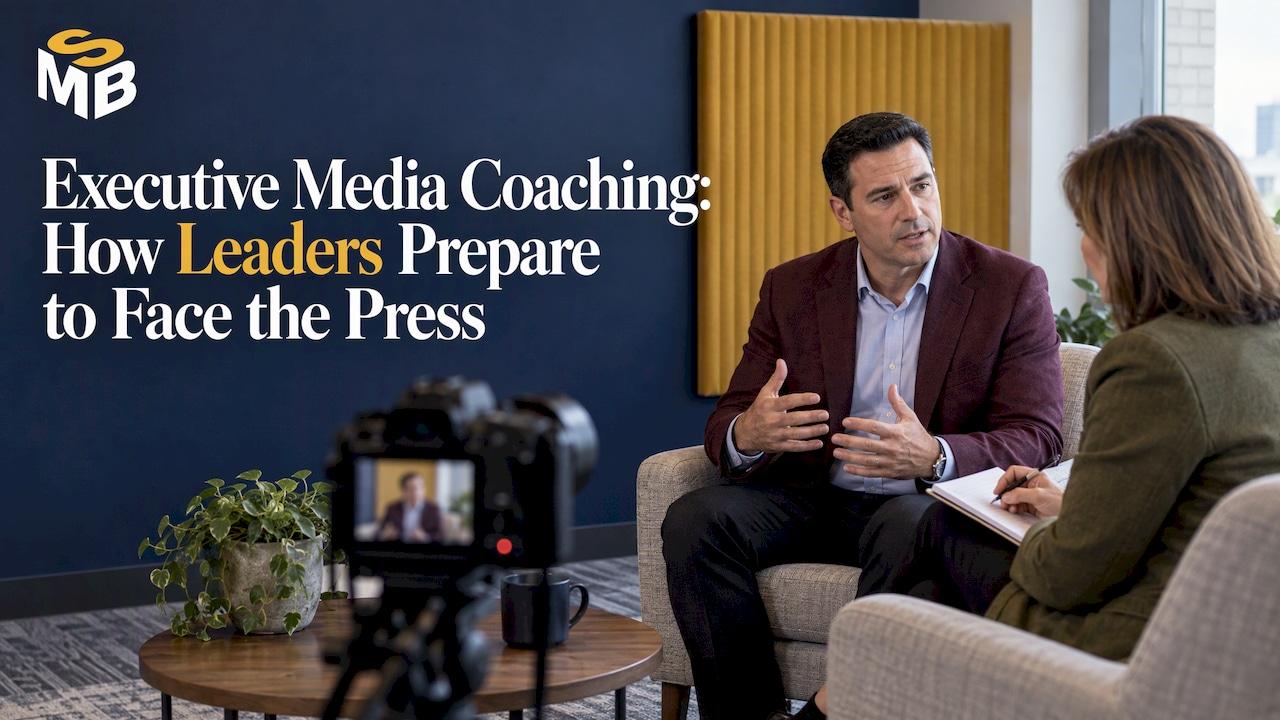
Executive media coaching is one-on-one preparation that teaches a leader to speak clearly, stay on message and handle hard questions in interviews with reporters, podcasters and broadcasters. Done well, it covers three things: what you want to say, how you say it under pressure, and what you do when the conversation turns hostile or goes off the rails. This guide walks through each, and shows where coaching fits in a wider crisis communications plan.
TL;DR
- Media coaching builds a leader's ability to deliver a few clear messages, in plain language, whatever the reporter asks.
- Preparation starts with purpose: know the audience, the format and the three points you want remembered. Postpone the interview if the messages are not ready.
- Answer honestly and briefly, then bridge back to your core message. Never speculate, and never say "no comment."
- Crisis spokespeople should be named and trained before an incident, not after one.
- One session is a start. Short, recurring drills are what make the skill stick.
Table of Contents
- What executive media coaching actually is
- Why leaders need it before the pressure arrives
- Preparing for an interview, step by step
- How to stay on message without sounding scripted
- Crisis media coaching is a different gear
- Making the skill stick
- Common mistakes to retire
- What to look for in a coach
- Getting support before you need it
- FAQ
- Sources
What executive media coaching actually is
Most leaders assume they can talk about their own company. Then a reporter asks a question they did not expect, a camera is pointed at them, and a clean answer turns into a rambling one. Media coaching closes that gap.
The work is personal. A coach looks at how you naturally speak, where you tend to over-explain, which words you reach for when you are nervous, and how you handle silence. Then you rehearse: realistic questions, a recorded playback, honest feedback, and another round. It differs from general presentation training because the audience is not in the room. A reporter will cut your answer down to a few seconds, and the public will only ever hear that excerpt.
That last point shapes everything. The American Association for the Advancement of Science advises interviewees to lead with the most important information, use plain language and examples, and prepare short sound bites, because editors often use only brief excerpts. A leader who gives a ten-minute answer has handed the editor the choice of which ten seconds to keep.
Coaching, training and counsel
The terms overlap. "Media training" usually describes the skills: message development, delivery, bridging, handling the on-camera moment. "Coaching" suggests an ongoing relationship with one leader. "Counsel" is the strategic layer: should this person do the interview at all, with which outlet, and for what purpose? The best engagements combine all three, because a well-trained executive in the wrong interview can still do damage.
Why leaders need it before the pressure arrives
The U.S. Centers for Disease Control and Prevention puts it bluntly in its crisis communication manual: even skilled communicators can make mistakes in a crisis, and no one should represent the organization without developing the appropriate skills. The same manual treats the spokesperson as part of the response itself. Credibility depends on the facts, and also on a trained person who conveys empathy, clarity and control.
I have watched this play out over more than three decades. The leaders who do well in a hard moment are rarely the most naturally charismatic. They are the ones who rehearsed, who knew their three points, and who had already practiced saying "here is what we know, here is what we do not know yet."
There are quieter reasons too. A product launch, an executive appointment, a new ad campaign or a corporate win all invite interviews. A leader who is comfortable with the press turns those moments into trust. A leader who is not may avoid them, and the story gets told by someone else.
Preparing for an interview, step by step
The sequence below is the one I return to with clients. It borrows from public guidance and from experience.
Start with purpose and audience
Before anything else, ask why you are doing this interview and who you want to reach. The CDC manual tells spokespeople to set a clear purpose and core messages, and to postpone the interview if the messages are not ready. That is a hard discipline for a busy executive, and it is the right one. An interview is not a favor to the reporter. It is a chance to say something specific to a specific audience.
Learn the basics as well: the outlet, the format, the journalist, the angle, the deadline. Red Thread EU, a European communications firm, recommends clarifying the audience, format, purpose, journalist and deadline before writing a brief with objectives, key messages, facts and examples. A one-page brief like that is worth more than an hour of improvised confidence.
Thinking about the audience also shapes your wording. If your team has not agreed on how the organization sounds, writing verbal identity guidelines can give every spokesperson the same vocabulary and tone to draw from.

Build a three-point message
AAAS suggests beginning with the interview goal, considering the audience, developing a three-point message, and supporting it with facts and anecdotes. Notice what is missing: a script. The same guidance says to practice delivery naturally rather than reciting it stiffly. Reporters can hear a memorized answer, and so can viewers.
A useful test: if the interviewer only had room for one sentence from you, which would you want it to be? Write that sentence first. Then write two more that support it.
Anticipate the hard questions
Sit down with your communications lead and write out every question you hope you are not asked. Then draft answers, and for each one find the bottom line, the single point the answer must land. The CDC manual recommends exactly this: work with public-information staff to anticipate questions, draft answers, find each answer's bottom line and rehearse. AAAS adds that you should get feedback from colleagues and prepare a written summary of your key points.
Do not skip the questions about money, lawsuits, layoffs, safety or leadership. Those are the ones reporters ask.
Set the ground rules
Agree on parameters in advance: topic, length, whether it is live, who else is being interviewed. Then assume everything you say is public. The U.S. Marine Corps Communication Directorate's media training guide notes that on the record is the safest default, since there is no reliable off-the-record protection. A comment made as the microphone is being unclipped still counts.
How to stay on message without sounding scripted
Staying on message does not mean repeating a slogan. It means returning, again and again, to what matters most to your audience, in new words and with new evidence. Think of it like a relay race: the reporter hands you a question, and your job is to carry the baton toward your own message without dropping it.
Answer first, then bridge
The CDC's guidance for difficult questions is a good working sequence: listen fully, pause, answer the question honestly and briefly, correct false premises in neutral language, and bridge back to a core message. The order matters. A bridge that skips the answer sounds evasive. An answer with no bridge leaves the agenda to the reporter.

Here is a quick illustration. A hospital CEO is asked, "Isn't it true patients are waiting longer than ever?" A weak reply argues about the word "ever." A stronger one answers plainly: "Wait times rose this year, and that is not acceptable to us." Then it bridges: "What matters now is what we are doing about it, and here are the three changes already under way." The first sentence earns trust. The second sets the direction.
Short, plain, and front-loaded
The Marine Corps guide recommends putting the main message first, using short statements of roughly 10 to 20 seconds, avoiding jargon, and avoiding words with negative connotations. That last piece is easy to miss. If a reporter says "disaster" or "cover-up," do not repeat it. Restate the point in your own language.
Pause
Silence feels longer to you than to the audience. AAAS advises pausing before you answer, avoiding nervous filler, and asking for clarification when a question is unclear. It also advises declining hypothetical questions and explaining why some questions cannot be answered. Never say "no comment." It sounds like concealment. "I cannot discuss that while the review is open, but here is what I can tell you" does the same job and keeps trust.
Do not fill the gaps
One of the commonest mistakes is rushing to fill a silence with extra information. The CDC cautions against speculation, accepting a reporter's loaded wording, and adding detail that was not asked for. If something is unknown, say so. If it is confidential, say that, and explain what you can share. Honest limits are more credible than confident guesses. For a team that wants to practice calm, honest delivery under strain, mindful communication exercises can be a useful complement to rehearsal.
Crisis media coaching is a different gear
A routine interview is a chance. A crisis interview is a test. The audience is larger, the questions are harder, and every word may be quoted for years. Crisis media coaching prepares for those conditions on purpose.
Name and train the spokesperson early
The CDC manual says organizations should identify and train crisis spokespersons before an incident, because a spokesperson personifies the response and helps establish credibility. The same guidance asks that spokespeople communicate with empathy and transparency, acknowledge what is known and unknown, avoid speculation and premature promises, and give regular updates with a unified message.
A 2021 Society for Human Resource Management report on public relations crises adds practical detail: assign one spokesperson, give employees a consistent statement, route media inquiries to that spokesperson, and use a holding statement to acknowledge the situation while you gather facts. It also quotes a communications director at PCL Construction recommending on-camera crisis training with interview questions, so leaders practice delivering statements under pressure.
Put it inside the plan
Training a spokesperson in isolation is not enough. The person needs a plan to stand on: who approves statements, what the holding statement says, which facts are confirmed, who speaks for which audience. Our guide to building a crisis communication plan covers those elements, and our piece on spokesperson training goes deeper on preparing leaders to speak for the organization.
The Transportation Research Board's Airport Cooperative Research Program documented how Southwest Airlines handled this. According to its case study, the airline maintained crisis communication plans, revised them quarterly, and integrated them into its emergency response plan. It also used scenario-based training for leaders, supported by playbooks. The lesson is that capability lives in the system, not in one gifted individual.
Rehearse the scenarios you fear
Practice works best against specific situations: a data breach, a safety incident, a lawsuit, an executive departure, a layoff. Our tabletop exercise scenarios give nine examples you can run with your leadership team, and the spokesperson can then face mock questions about each.
Making the skill stick
A single half-day session produces a good feeling and a short memory. Skills fade when they are not used. Agility PR Solutions makes the case for recurring short drills over one-off preparation: rehearse a 30-second answer, a hostile-question bridge, and different versions for broadcast, trade media and podcasts, then review what held up.
A simple rhythm works for most organizations:
Before every interview, spend fifteen minutes on the brief, the three points and the three hardest questions. After every interview, spend ten minutes asking what landed, what did not, and what to change. Each quarter, run one scenario drill with the full leadership team, and update messages and holding statements as facts change. Once a year, record a mock interview and watch it back. Seeing yourself is uncomfortable, and it is the fastest teacher there is.
Common mistakes to retire
Certain errors turn up again and again. Leaders ramble because they fear silence. They argue with a reporter's framing instead of reframing it. They memorize talking points and sound robotic. They treat a casual chat before or after the recording as private. They promise outcomes too early. And they send the most senior person to every interview, when a subject expert might serve the audience better.
The fixes are rarely complicated. They are habits, and habits form through repetition with feedback.
What to look for in a coach
Choose someone who has sat on your side of the table, who understands your industry's pressures and who will tell you the truth about your delivery. Ask how they tie media preparation to your wider communications and crisis plan. Ask who will be in the room when a real event occurs. A coach who disappears after the workshop leaves a gap exactly when you need help most.
Industry context matters, too. Healthcare leaders face privacy rules and patient-safety questions; our guide to healthcare crisis communications shows how those constraints shape what a spokesperson can say. Casinos, law firms, financial services and technology companies each carry their own sensitivities, and the preparation should reflect them.
Our perspective
We have spent over 30 years advising leaders in the hours when the cameras arrive, and one thing has not changed: the interview people fear is rarely the one that hurts them. What hurts is the absence of preparation. A leader who has not decided what matters will let the reporter decide.
That is why we do not treat media coaching as a standalone workshop. We pair preparation with real-time response. The same people who help you build the message are the ones who can stand beside you when a story breaks, with a network of experts behind them.
We also believe credibility comes from action, not wording. The best answer in the world cannot carry a decision the public finds hollow. So we work on both: what you say, and what you credibly do next. Handled that way, a difficult moment can become a chance to show who your organization is.
Mark
Getting support before you need it
If your organization is facing public scrutiny, preparing for a launch or an executive change, or simply has no trained spokesperson, the time to build that capability is now. Mark Brown Strategies offers crisis management and communications, crisis readiness assessments, reputation management and recovery, corporate communications and more, for organizations across California, Nevada, Arizona and Utah.

To talk through your situation, visit Mark Brown Strategies and start a conversation about your readiness.
FAQ
How is media coaching different from media training?
Media training usually refers to the skills: message building, delivery, bridging and handling cameras. Coaching implies a continuing, personalized relationship with one leader, including strategy about which interviews to take. Many providers use the terms interchangeably, so ask what the engagement includes.
How do I handle a question I do not want to answer?
Pause, then be honest about the limit. Say what you cannot confirm or discuss, explain why if you can, and move to what you can share. AAAS advises avoiding "no comment," because it sounds like hiding something.
What is bridging in a media interview?
Bridging is moving from the reporter's question to your own message after you have answered it. You respond briefly and honestly, then connect to a core point, for example by saying that what matters most is what you are doing about the issue. Bridging without answering first sounds evasive.
When should an executive say no to an interview?
When the messages are not ready, the facts are unconfirmed or the purpose is unclear. The CDC manual advises postponing the interview until core messages are in place. Offering a holding statement and a later time is usually better than an unprepared answer.
Sources
- Crisis and Emergency Risk Communication: Spokesperson (CDC)
- Media Interviews (AAAS Communication Toolkit)
- Communication Directorate Media Training Guide (U.S. Marine Corps, August 2022)
- How to brief a CEO for a media interview (Red Thread EU)
- Risk Managers: What's Your Plan for a Public Relations Crisis? (SHRM)
- Southwest Airlines case study on social media and emergency management (ACRP)
- Why your media training isn't sticking (Agility PR Solutions)